At a glance
| Detail | |
|---|---|
| What it is | Mountain massif behind Kotor, crowned by the Njegoš Mausoleum (1,657 m) |
| From Bečići | ≈45 km · 1–1.25 h via the serpentine road |
| Costs | ~€3 park entry + ~€8 mausoleum (cash, charged separately) |
| The climb | 461 steps to the mausoleum (~15–25 min); open ~9–5 Apr–Nov |
| The road | Kotor–Lovćen serpentine — ~25 hairpins over ~8 km |
| Best for | Mountains, the Njegoš Mausoleum, panoramic views |
| Time needed | Full day (pairs with Cetinje + Skadar) |
The spiritual heart of Montenegro
Lovćen National Park is the mountain massif that Montenegrins treat as the spiritual heart of the country — the "Black Mountain" that arguably gave the nation its name. This rugged core kept Montenegro de facto independent even as the Ottomans swallowed the rest of the Balkans, held by warrior clans under the prince-bishops of Cetinje. Jezerski Vrh, its second-highest peak, is crowned by the Mausoleum of Petar II Petrović-Njegoš, the 19th-century prince-bishop, poet and philosopher whose tomb sits at 1,657 m — said to be the highest mausoleum in the world — with one of the widest views in the Balkans: on a clear day, the coast, the Bay of Kotor and, they say, almost half of Montenegro.
The mausoleum climb
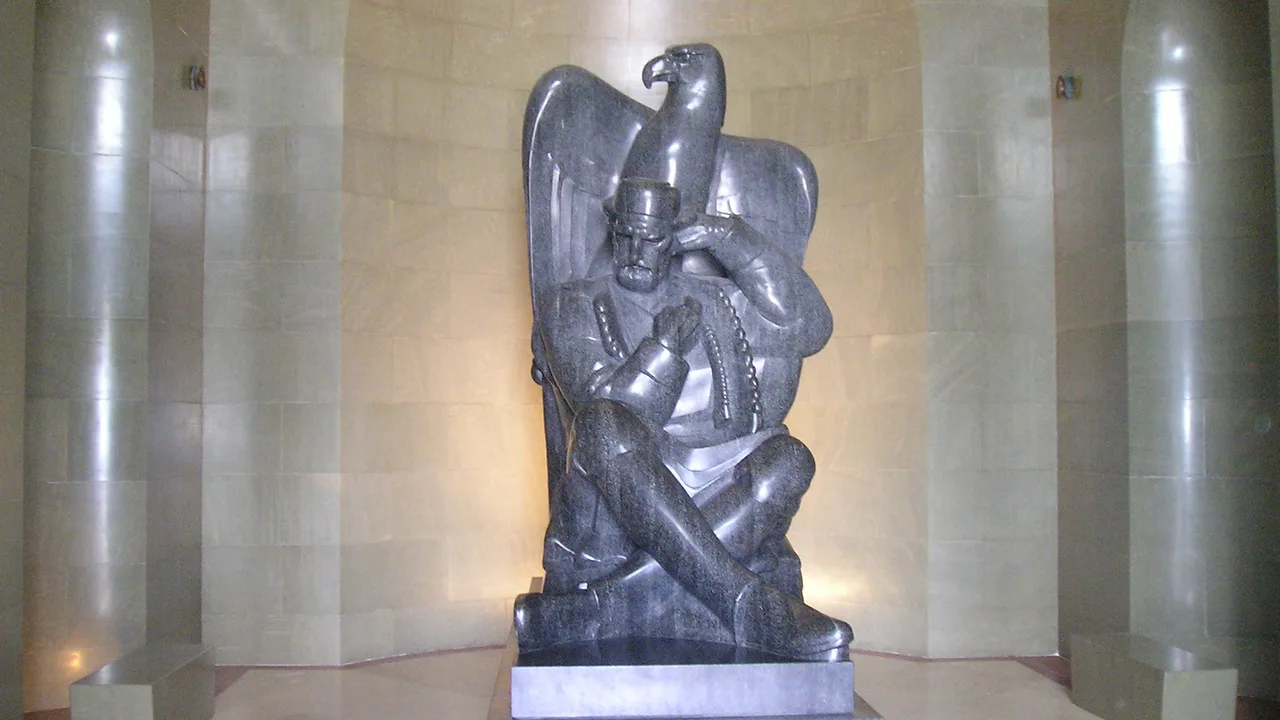
From the summit car park, 461 stone steps climb to the mausoleum entrance — reckon on 15–25 minutes at a steady pace in the thin mountain air. Inside, designed by the sculptor Ivan Meštrović and completed in 1974, a 28-tonne granite Njegoš sits beneath a canopy of some 200,000 gilded tiles; behind, a circular terrace opens onto the panorama. Costs in 2026: around €3 to enter the park, plus about €8 for the mausoleum, charged separately at the top — carry cash. The mausoleum is open daily, roughly 9am–5pm (April–November) and 9am–4pm in winter, so don't leave the climb too late in the day.
Getting there
Half the fun is the drive: the old Kotor–Lovćen serpentine climbs the mountain in a stack of around 25 hairpins over roughly 8 km. From Bečići, allow an hour to 75 minutes to reach the park. If the hairpins don't appeal, there are two easier ways up: the modern Kotor–Lovćen cable car (Dub station near Kotor up to Kuk at 1,348 m, ~11 min, roughly €15–22 return), or an organised tour — most string Lovćen together with Cetinje and Skadar Lake into one full inland day. Layer up: the summit is far cooler and windier than the coast, even in July.