At a glance
| Detail | |
|---|---|
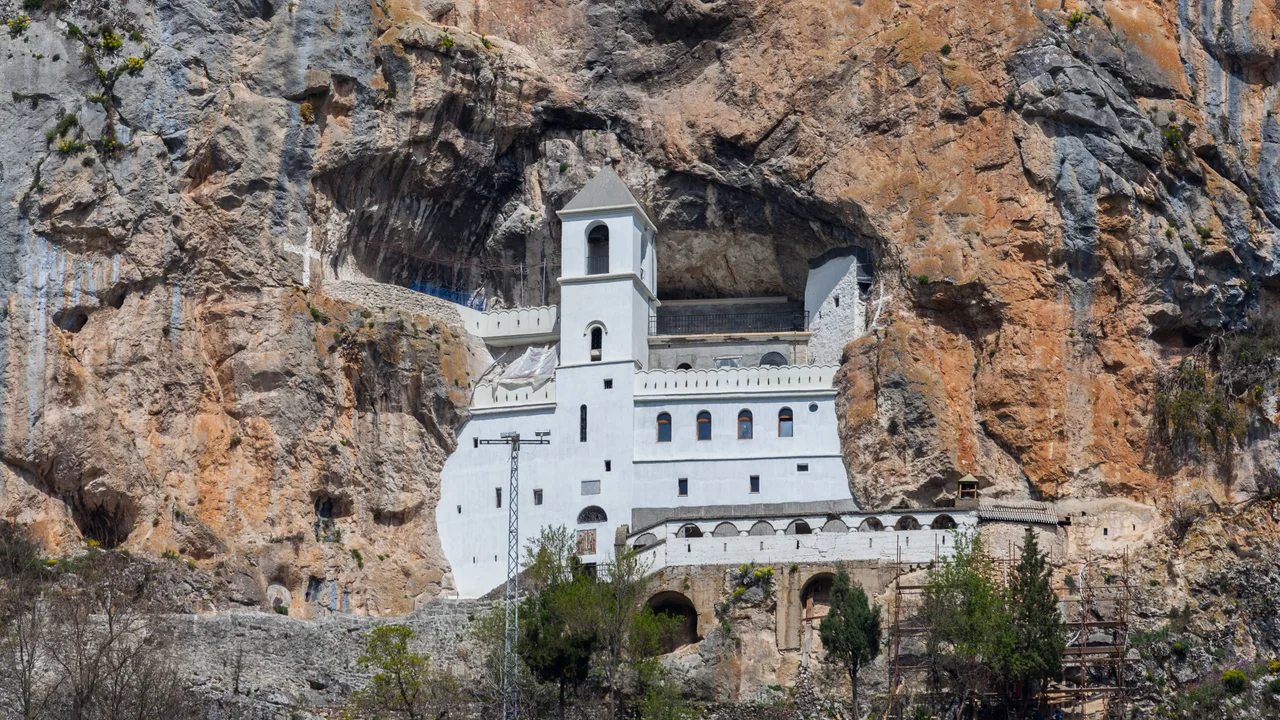
| What it is | Whitewashed 17th-c monastery built into a sheer cliff — Montenegro's top pilgrimage site |
| From Bečići | ≈100 km · 2–2.5 h each way — a full-day trip |
| Cost | Free (donations); an organised tour is ~€20–35 pp |
| Two parts | Lower Monastery (car park) + Upper Monastery (~3 km up, St Basil's relics) |
| Dress code | Shoulders and knees covered; no beachwear |
| Best time | Early morning — parking, cooler air, fewer crowds |
| Best for | Pilgrimage site, cliff monastery, history |
A monastery in a cliff
No day trip from the beach at Bečići feels as different from the coast as Ostrog — a gleaming white monastery carved into a near-vertical cliff in the 17th century and dedicated to St. Basil of Ostrog (Sveti Vasilije), whose relics are kept here. Whitewashed and seemingly glued to the grey rock, it is one of the most dramatic sights in the Balkans and Montenegro's most-visited pilgrimage site — indeed the single most-visited shrine in the Serbian Orthodox Church — drawing up to 1.2 million visitors a year of every faith: Orthodox, Catholic and Muslim. It is a genuinely working, sacred place, not a museum.
The two monasteries
Ostrog comes in two parts. The Lower Monastery (Donji Manastir) sits at the foot of the approach, with a church, pilgrim accommodation and a car park. The Upper Monastery (Gornji Manastir) is the famous white shrine set into the cliff, about 3 km further up a steep road, home to St. Basil's relics — the one in every photograph. You can drive between the two, or do as pilgrims do and walk the path up (a sweaty 30–45 minutes uphill; some climb the final stretch barefoot). Entry is free — the monastery runs on donations — but dress modestly: shoulders and knees covered, no beachwear.
Getting there
Ostrog sits well inland, so this is the longest of the popular Riviera day trips: roughly 2 to 2.5 hours each way, making it a full-day outing. The final approach to the Upper Monastery is narrow, steep and full of tight hairpins, with limited parking that fills fast in summer. If you are not confident on mountain roads, an organised tour (~€20–35 per adult) is the easy call. Whichever you choose, go early — for a parking spot, cooler air, and to beat the tour coaches; weekends and Orthodox holy days are busiest.